
Despite repeated Bitcoin corrections, luxury travel demand has shown surprising resilience. Ultra-high-net-worth travelers tend to operate beyond short-term market volatility, prioritizing lifestyle continuity, asset diversification, and experiential capital. For many wealthy individuals, travel is no longer discretionary — it is structural.
Bitcoin has been through enough boom and bust cycles to make even seasoned investors stop checking the chart on weekends, but the current drawdown is not just an abstract headline. In early February 2026, multiple outlets reported sharp declines from the late 2025 peak, along with visible stress inside parts of the crypto lending and liquidity ecosystem, including a reported withdrawals pause at BlockFills amid the broader downturn.
That said, the more important question for luxury travel is not “Is Bitcoin down,” because Bitcoin is always down or up in a way that feels dramatic; the real question is whether a crypto drawdown changes how affluent travelers behave when it comes to discretionary spend, and whether it changes how travel gets purchased and paid for. The answer is nuanced, and for premium travel, it is often more constructive than people assume.
#What tends to happen to luxury travel demand when crypto falls
When crypto is rising aggressively, you see a specific type of “celebratory” demand: shorter lead times, higher appetite for high visibility venues, more impulsive villa upgrades, and a greater willingness to spend on status signaling, including last-minute tables, elevated bottle service, or multiple destination hops. When crypto falls sharply, the demand does not disappear, but it becomes more disciplined, more intentional, and more operationally optimized.
In practice, three things typically occur:
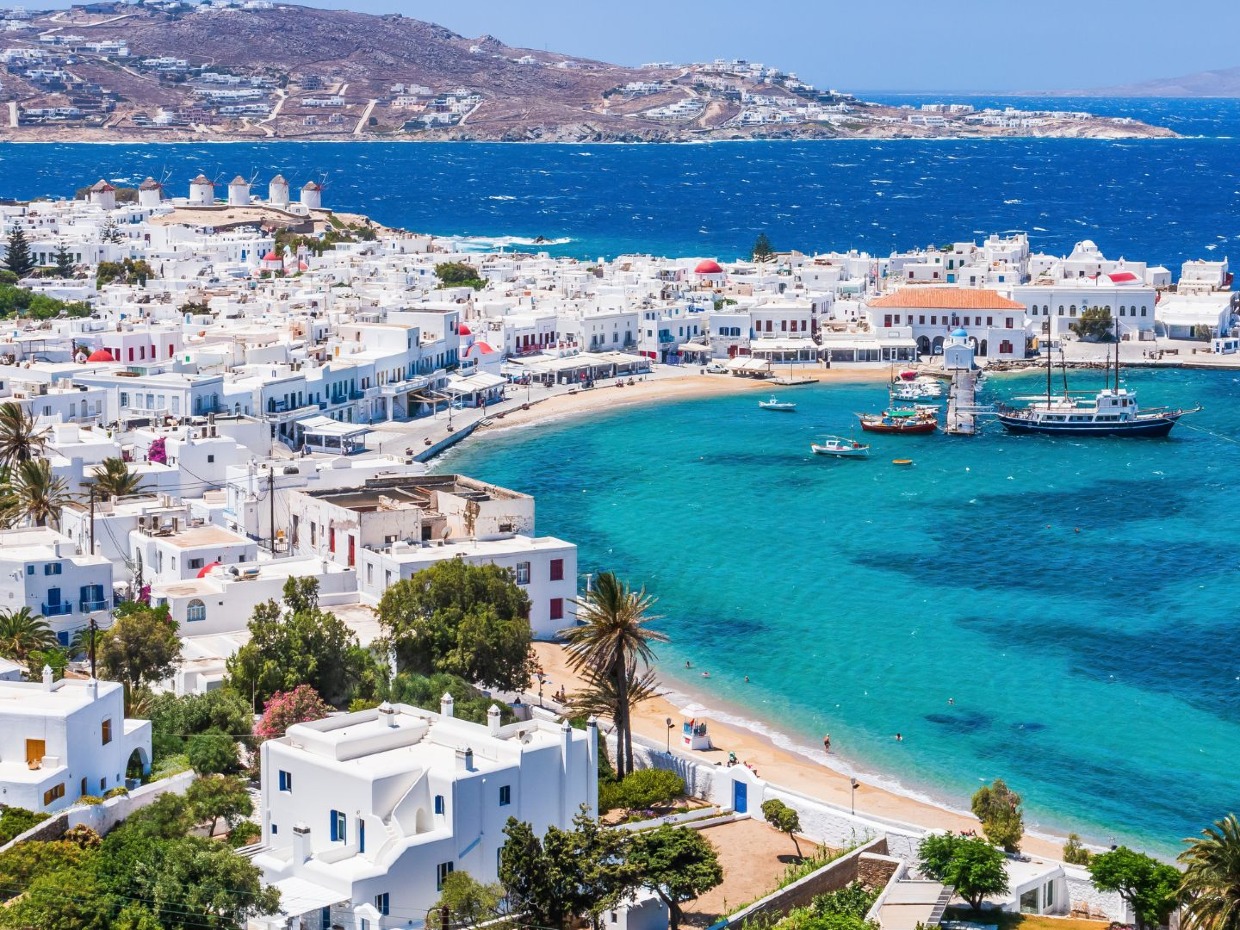
The trip stays on the calendar, but the structure tightens. Travelers who already value Mykonos as a summer base do not suddenly decide to stop traveling; instead they reduce unnecessary friction (fewer moves, fewer destinations, fewer “just because” upgrades) and concentrate spend where it produces the greatest experience per decision.
The payment preference shifts. During drawdowns, many clients prefer not to liquidate a volatile asset at a low point, so they either pay with fiat, pay with stablecoins, or use payment rails that allow crypto spending without forcing them into a clumsy exchange process. This is where the infrastructure has improved materially in the last 18 to 24 months.
The demand for discretion and control increases. In uncertain markets, privacy and predictability become even more valuable; a properly run private villa stay with a tight operating plan often feels safer and calmer than an overly social schedule that relies on peak-time availability.
#The underreported story: crypto payment rails for travel are maturing quickly
Here is the part most commentary misses: crypto volatility does not reduce the number of people who hold crypto, it mainly changes whether they want to sell it today, and the travel industry has been quietly building payment options that help clients spend without the usual friction.
Recent reporting and industry commentary repeatedly point to growth in crypto payments for travel, with stablecoins taking a meaningful share of payment volume because they reduce volatility risk while preserving the advantages of speed and cross-border convenience.
There are also travel platforms explicitly positioning themselves as crypto-friendly for booking flights and hotels, and they emphasize multi-coin acceptance including stablecoins.
In parallel, large payments players are publicly tracking merchant adoption and reporting strong interest in hospitality and travel, which matters because once the rails are easy, clients do not have to “make a crypto payment a project.”
So while Bitcoin can fall 20 percent in a week and make headlines, the practical ability to pay for premium travel using crypto or crypto-linked rails is not moving backward; if anything, it is becoming more normalized, particularly for internationally mobile clients who care about speed, discretion, and simplicity.
#Prognosis: what do forecasts suggest, and how should a traveler interpret them
Bitcoin “prognosis” is a dangerous word because forecasts are not facts and anyone who tells you they know the number is selling something, but it is still useful to understand the range of credible scenario thinking.
Several market-facing forecast pages explicitly emphasize uncertainty while outlining wide ranges for 2026 outcomes, which is precisely the point: volatility is not a bug of Bitcoin, it is a defining feature of the asset. For example, one analysis source presented 2026 scenarios spanning a broad band and noted alternating periods of growth and deep corrections.
Other forecast summaries similarly show broad dispersion across third-party predictions and stress that macro factors, regulation, and liquidity conditions can change the path quickly.
On the institutional commentary side, Galaxy Digital has been publicly associated with a long-term bullish outlook into 2027 while acknowledging uncertainty in 2026, which again reinforces that short-term turbulence can coexist with longer-term adoption narratives.
For travel planning, the practical takeaway is not “buy or sell,” it is that if you intend to fund lifestyle through crypto, you should assume volatility and design a payment approach that protects your experience.
#The Cloud 9 view: how top-tier travelers keep traveling through volatility
When markets are noisy, the most sophisticated travelers do not cancel travel, they reduce chaos. What they buy is not “more luxury,” but better control. In Mykonos terms, that typically means:
Choosing a villa as the operating base, because it reduces exposure to peak-time friction while improving privacy and recovery.
Consolidating experiences so the week feels curated rather than chased.
Using payment options that fit the client’s balance sheet mindset, including stablecoin settlement or structured invoicing, where appropriate, to avoid forcing a bad-timing liquidation.
This is why a Bitcoin crash does not automatically imply a luxury travel crash. It implies a shift in how luxury is expressed: less impulsive visibility, more engineered ease.
A simple, traveler-friendly rule: if you are crypto-heavy, do not let a chart decide your summer. Decide your summer, then structure your payments intelligently.
Note: This is not financial advice. Crypto is volatile; forecasts are uncertain; consult a qualified professional for investment decisions.