.jpg)
#A data-backed look at how luxury villas became the real center of power on the island—and why execution now matters more than access.
Mykonos has always been good at selling a fantasy.
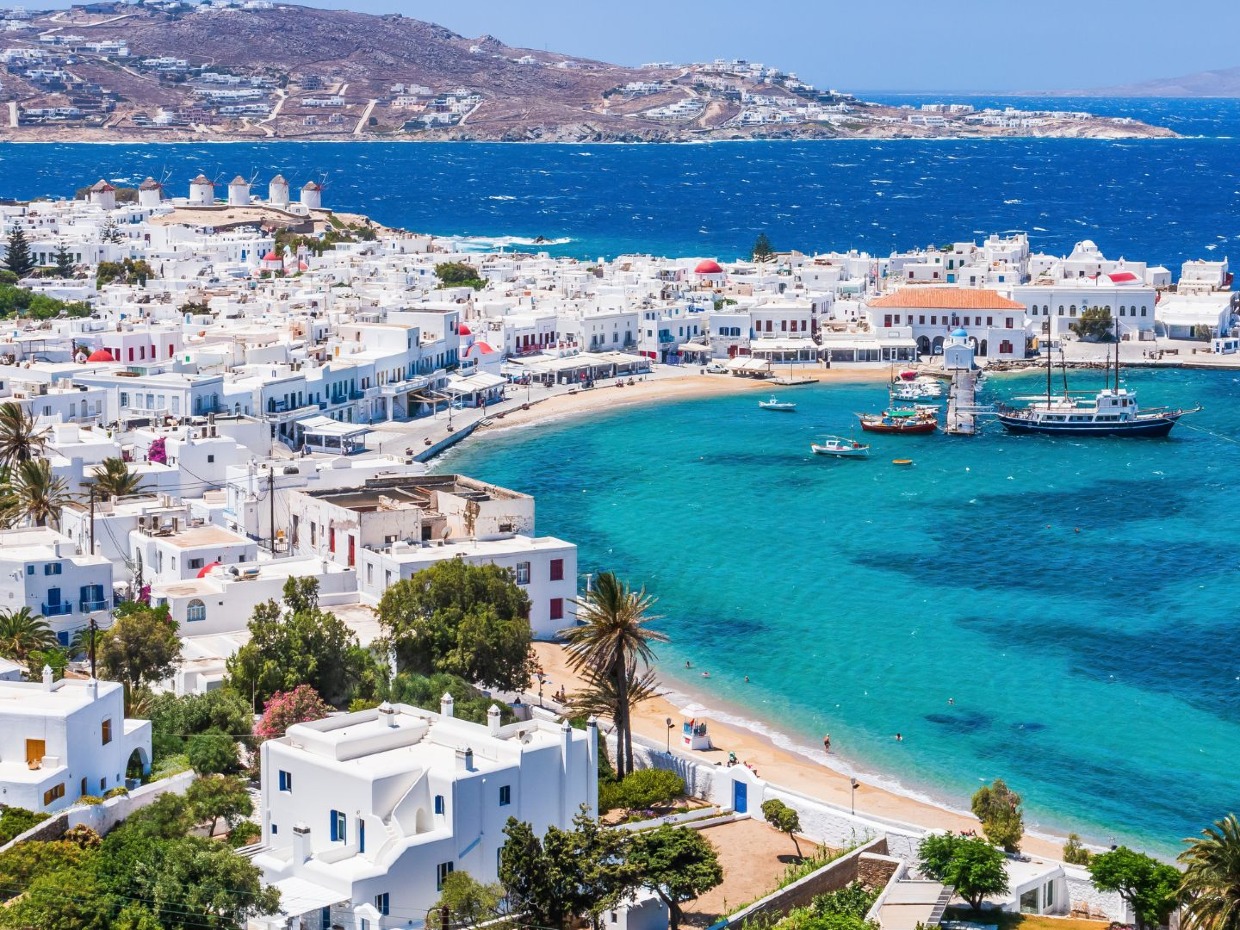
White curves against cobalt water. Sunlight that feels almost engineered. Music that seems to begin in the afternoon and never quite ends. The kind of visual perfection that makes people believe the experience must be equally effortless.
And yet, behind that image, a quieter shift has taken place over the last decade, accelerating sharply post-2020 and now fully defining the 2026 luxury landscape:
Mykonos is no longer a hotel-led destination. It is a villa-led ecosystem.
That change sounds cosmetic. It isn’t. It has fundamentally restructured how luxury travel on the island is designed, delivered, and judged.
Because once the center of gravity moves from hotels to private villas, everything else—yachts, beach clubs, transportation, staffing, security, timing—stops being a list of bookings and becomes a system that has to be actively managed.
That is the part most people never see.
#The rise of villa culture: not a trend, a structural shift
The global data is clear.
Across luxury travel reports from firms such as Virtuoso, Knight Frank, and McKinsey’s travel insights, one pattern repeats: high-net-worth travelers are moving away from traditional hotels toward private, controlled environments.
Demand for luxury villa rentals has outpaced hotel growth in multiple Mediterranean markets since 2021
Group travel and multigenerational trips are now one of the fastest-growing luxury segments
Clients increasingly prioritize privacy, flexibility, and personalization over brand affiliation
Mykonos sits at the intersection of all three.
It offers:
dense high-end inventory
strong nightlife and social infrastructure
proximity to other Cycladic destinations
and a cultural expectation of private hosting
Which is why the island has quietly become one of the most mature villa ecosystems in Europe.
But here is the nuance.
The growth of villa culture did not simplify luxury travel.
It made it exponentially more complex.
#A villa is not a booking. It is an operating environment.
Hotels are systems.
They have staffing structures, service protocols, supply chains, and internal coordination mechanisms built over decades. You arrive, and the system absorbs you.
A villa does not.
A villa is a blank canvas with premium architecture.
Everything else must be built around it:
staffing (housekeeping, chefs, service personnel)
provisioning (food, drinks, preferences)
logistics (drivers, transfers, timing)
experiences (yachts, beach clubs, reservations)
daily rhythm (when the group wakes, moves, rests, socializes)
Without proper orchestration, a €20,000-per-night villa becomes exactly what it is on paper:
A house.
A very beautiful one, but still just a house.
This is where Mykonos separates experienced operators from casual planners.
Because on this island, the villa is not the product.
The experience inside and around the villa is.
#The invisible economy behind Mykonos villas
To understand villa culture in Mykonos, you have to understand that there are two markets operating simultaneously.
#1. The visible market
Listings, platforms, agencies, glossy presentations.
#2. The invisible market
Relationships, priority access, repeat clients, quiet allocations, timing leverage.
The visible market is what most people interact with.
The invisible market is what defines the outcome.
For example:
Two clients can book villas at the same price point and have completely different experiences
Two groups can go to the same beach club and receive entirely different positioning
Two yacht days can cost the same and feel entirely different
The difference is rarely the asset itself.
It is how the ecosystem around it is managed.
This is where experienced on-ground operators—those who live inside the system daily—create disproportionate value.
At Cloud 9 Concierge, this is exactly where we operate: not at the level of “what to book,” but at the level of how everything interacts once booked.
#The psychology of villa clients: control, not display
Luxury villa clients in 2026 are not necessarily chasing visibility.
They are chasing control.
Control over:
who enters their space
how their day unfolds
how flexible their plans can be
how much friction they experience
This is a subtle but important shift.
In the past, luxury in Mykonos was partially performative—tables, visibility, presence.
Today, the highest-value clients often move differently:
private villa anchors
selective public exposure
controlled social access
curated experiences
They don’t want more options.
They want better decisions made on their behalf.
Which brings us to the real tension in villa culture.
#Why villa-based luxury trips fail more often than hotel-based ones
This is not widely discussed, but it is observable across the industry.
Villa-based trips fail more frequently than hotel-based trips—not dramatically, but structurally.
Why?
Because:
there is no central system managing the experience
responsibility is fragmented across multiple vendors
timing becomes critical and often misaligned
expectations are higher due to price point
The failure points are subtle:
the chef arrives late
provisioning is incomplete
transfers are not synchronized
reservations are technically correct but poorly positioned
the day lacks flow
None of these issues destroy the trip.
But they dilute it.
And in luxury, dilution is expensive.
#The role of timing: Mykonos does not forgive poor sequencing
Mykonos operates on compressed time.
peak windows are short
movement is concentrated
demand spikes quickly
A villa day is not simply “wake up, relax, go out.”
It is a sequence:
late morning energy
afternoon escalation
sunset transition
evening positioning
nightlife integration
If that sequence is misaligned, the entire experience feels off.
For example:
arriving too early at a beach club kills energy
arriving too late reduces positioning
poorly timed transfers create stress
mismatched dinner timing breaks rhythm
The villa sits at the center of this sequence.
It must absorb, adapt, and relaunch the day.
That requires active management.
#The Meltemi effect: why weather is part of villa culture
The Meltemi wind is not just a weather feature.
It is a strategic variable.
It affects:
which villas feel comfortable at certain times
which beaches are usable
which yacht routes are optimal
how long outdoor setups remain viable
Experienced operators read it daily.
Inexperienced planners ignore it until it becomes a problem.
Handled correctly, the wind enhances the experience:
cooler temperatures
fewer insects (almost no mosquitoes)
longer comfortable outdoor time
Handled poorly, it disrupts logistics.
Villa culture in Mykonos is therefore partly about architecture, and partly about adaptation to environment.
#The new luxury stack: villa + yacht + concierge = baseline
In 2026, high-end Mykonos travel has a new baseline structure:
Villa (primary base)
Yacht (mobility + experience layer)
Concierge (coordination layer)
Remove the third, and the system weakens.
This is the part many travelers underestimate.
They invest heavily in the first two, then treat the third as optional.
In reality:
the villa creates potential
the yacht creates experience
the concierge creates cohesion
Without cohesion, luxury fragments.
#Data insight: where money is actually being spent
Based on aggregated industry patterns and internal observations:
40–60% of high-end Mykonos trip budgets now go to villas
15–25% to yacht experiences
10–20% to F&B and nightlife
5–10% to logistics and concierge
Yet the last category disproportionately affects satisfaction.
This is one of the most interesting asymmetries in luxury travel:
The least visible cost often drives the highest impact.
#Why Mykonos villa culture keeps growing
Despite complexity, demand continues to increase.
Why?
Because when executed correctly, the experience is unmatched.
Villa culture offers:
privacy with optional exposure
flexibility without constraints
personalization at scale
emotional ownership of the trip
You are not a guest.
You are the center.
And once clients experience that properly, they rarely go back to traditional formats.
This is why Mykonos has one of the strongest repeat client patterns in Europe.
#The Cloud 9 layer: where execution becomes invisible
The highest compliment in villa-based luxury is not praise.
It is absence of friction.
When:
the day flows naturally
adjustments happen silently
nothing feels rushed or delayed
decisions appear effortless
That is not luck.
That is execution.
At Cloud 9 Concierge, this is the layer we focus on.
Not the obvious bookings.
But the invisible mechanics:
sequencing
timing
adjustments
coordination
anticipation
Because in Mykonos, the difference between good and exceptional is rarely visible.
It is felt.
#Final thought: villa culture is not about luxury. It is about control
Mykonos villa culture is often misunderstood as indulgence.
It is not.
It is a pursuit of control in an environment that naturally resists it.
The island is dynamic.
Demand is intense.
Conditions shift constantly.
The villa is the anchor.
But the experience is everything that moves around it.
And the ones who truly understand Mykonos are not the ones who book the best villas.
They are the ones who know how to make the entire system work together.